Train Climbing Roses Around Balcony Doorways with Tension Wire
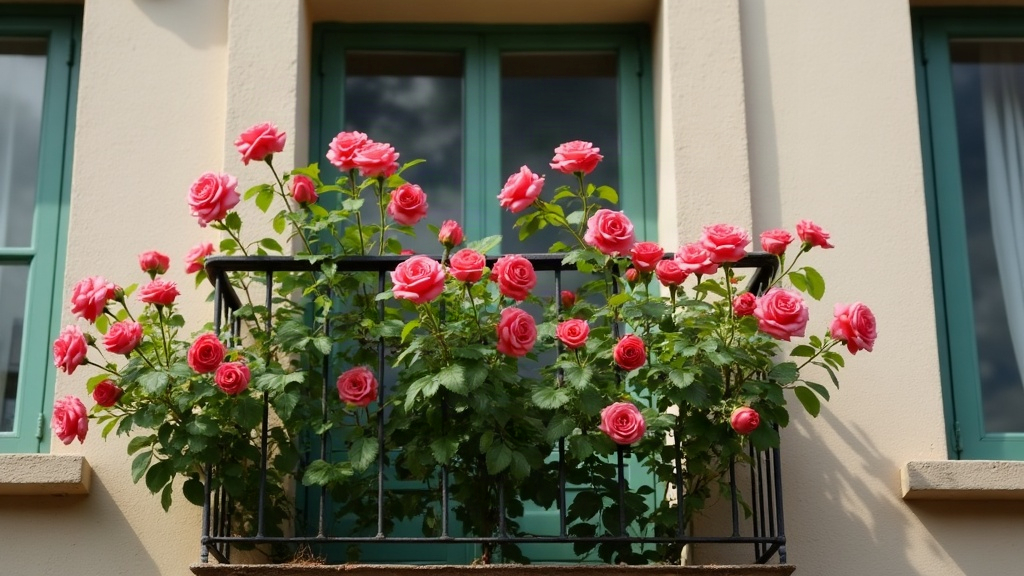
Training miniature climbing roses around an apartment balcony doorway with tension wire gives you a living archway that softens all that hard architecture, saves floor space you don’t have to spare, and turns a plain entrance into something people actually stop and smell. The method itself is simple: thin steel cables anchored with eye screws and turnbuckles instead of a bulky trellis panel. That makes it a good fit for renters and small balconies, where drilling is limited and every square inch counts.
Why Tension Wire Works Better Than a Trellis for Doorways
A rigid trellis panel is heavy, it blocks light through glass doors, and it almost never fits the odd angles around a doorframe. Tension wire sidesteps all three problems at once.
- Low profile: 2-3mm stainless steel cable practically disappears against a wall, so it never competes with the flowers for attention.
- Custom shape: run the wires horizontally, vertically, or fan them out to match whatever width and height your doorway happens to be.
- Minimal drilling: a handful of small eye screws carry the whole system. Compare that to a full lattice, which needs fastening points every foot or so.
- Airflow and light: wires don’t block sightlines or ventilation the way a solid panel does, and that matters for a door you’re opening and closing every day.
Choosing the Right Miniature Climbing Rose
Not every rose sold as a “climber” belongs on a container and a doorway-sized frame. You want compact climbers, sometimes marketed as “patio climbers,” bred to stay under 6-8 feet. A few worth looking for:
- ‘Nice Day’, repeat-flowering, disease-resistant, tops out around 6 feet.
- ‘Laguna’, vigorous but still manageable, arches nicely over a frame.
- ‘Jeanne Lajoie’, a genuine miniature climber and probably your best bet on a tighter balcony, reaching only 4-6 feet.
If your balcony can’t give the roots an in-ground run, pick a variety labeled for container growth. These have been bred to bloom heavily even with a restrained root system, which is exactly what a pot gives them.
Installing the Tension Wire System
1. Map the Anchor Points
Mark two or four points around the doorframe (top corners, and mid-height points if you want more support) where the eye screws will go. Anchor into masonry or the door’s structural frame, never into window sealant strips or decorative trim, those won’t hold.
2. Install Eye Screws and Turnbuckles
- Drill pilot holes and use wall plugs rated for real tension. Even a light-gauge cable pulls harder than you’d guess once the foliage fills in and adds weight.
- Screw stainless eye bolts into each anchor point.
- Attach a turnbuckle to one end of each wire run. This is the part that saves you from re-drilling later: as the rose grows, you just tighten the turnbuckle instead of starting over.
3. Run and Tension the Wire
Thread 2-3mm coated steel wire through the eyes, loop it back through a wire clamp or crimp sleeve to lock it in place. Tighten the turnbuckle until the wire is taut, but not so tight it hums like a guitar string. You want just enough tension to hold canes without sagging.
4. Space Horizontal Runs for Lateral Growth
For repeat bloomers, space the horizontal wires 12-15 inches apart up each side of the doorway, then curve them across the top. This spacing pushes canes to grow sideways rather than straight up, and sideways growth is what actually triggers more flowering laterals.
Training Technique: Bend, Don’t Force
Here’s the biology behind it: roses bloom more heavily on canes trained horizontally or at an angle because bending interrupts apical dominance, the hormonal signal (auxins) that tells the plant to keep growing upward instead of branching out. Bend the cane, and the plant redirects that energy into side shoots instead.
In practice:
- Once new canes hit 12+ inches, arch them gently along the nearest wire and secure with soft plant ties (never wire, which will girdle the stem) about every 8-10 inches.
- Skip sharp bends. A gradual curve keeps young, still-woody canes from snapping.
- Keep ties loose in the first season. Canes thicken faster than you’d expect, and anything tied snugly this year will be cutting into the bark by year two.
Container and Watering Considerations
The rose is living in a pot by the door, not in garden soil, so a few things change:
- Go with at least a 15-18 inch diameter container and make sure drainage is excellent. Even “miniature” climbers need real root volume to keep pumping out blooms.
- Water deeply 2-3 times a week in summer heat. Balcony pots dry out much faster than garden beds do, sometimes within a day in direct sun.
- Feed with a balanced rose fertilizer every 4-6 weeks through the growing season. Horizontal training means more blooms, and more blooms means the plant needs more fuel to sustain them.
Maintenance Through the Seasons
- Spring: loosen the ties, check turnbuckle tension (winter cold can shrink the cable slightly), and prune out dead or crossing canes.
- Summer: re-tie new growth on a weekly basis during the peak growth spurt, and deadhead spent blooms to keep the repeat flowering going.
- Fall: cut back on feeding and tidy up any canes that have outgrown the wire frame.
- Winter: in cold climates, ease off the tension a bit and wrap the base of the container so the roots don’t get hammered by freeze-thaw cycles.
Common Mistakes to Avoid
- Over-tightening the wire before the rose has filled in. A gust of wind can pull the anchor points loose before the plant is mature enough to provide any counterbalance.
- Using zip ties or bare wire directly on canes. They’ll girdle the cane and kill it as it thickens, sometimes without you noticing until the cane above the tie just dies.
- Picking a full-size climber. Anything that reaches 15+ feet will swamp both the frame and your doorway within two seasons, no matter how hard you prune.
Conclusion
Tension wire is about as space-efficient and visually light a way as you’ll find to train a miniature climbing rose around a balcony doorway. Pick a compact variety, anchor the wire at the right points, train the canes to grow sideways instead of straight up, and you end up with denser blooms, better airflow, and a doorway that looks like it was designed that way on purpose, not one that just got overgrown by accident. And you get all of it without a bulky trellis eating into balcony space you never had much of to begin with.