Overwintering Potted Japanese Maples on Windy Urban Terraces
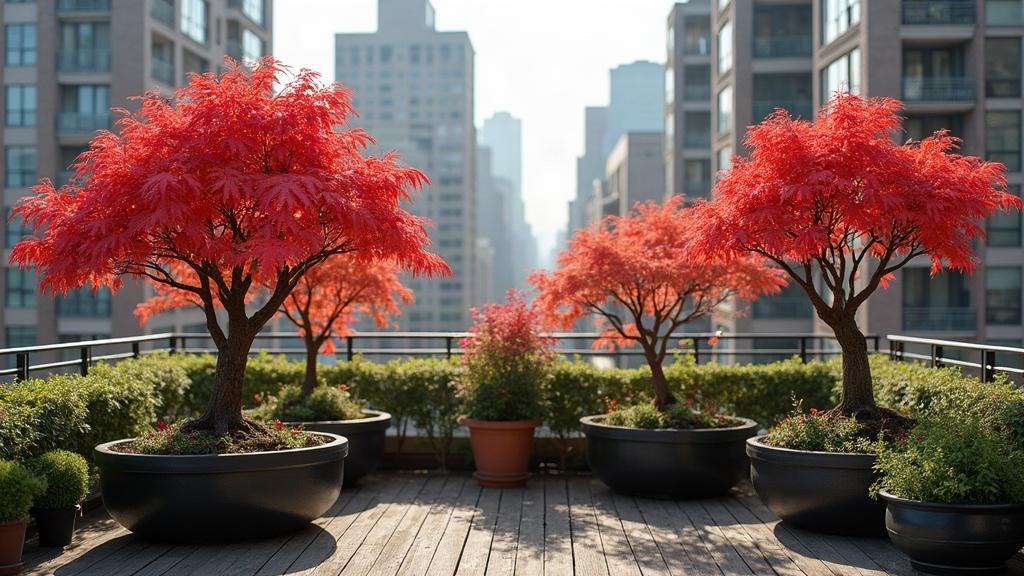
Overwintering potted Japanese maples on a wind-whipped urban terrace takes more than tossing burlap around the trunk and calling it done. You need to protect that vulnerable root ball from freeze-thaw cycles, shield the delicate branches from drying wind, and think carefully about where the pot actually sits so it doesn’t tip over or crack at the base. Get this right, and your Acer palmatum will make it through a brutal rooftop winter and leaf out just as beautifully come spring.
Why Terraces Are Especially Risky for Potted Maples
Ground-planted maples have soil insulating their roots on every side. Container maples don’t get that luxury. Roots in a pot are exposed to ambient air temperature from all directions, and on a terrace, that risk stacks up fast:
- Wind chill pulls moisture out of both foliage and root zone, even while the tree is fully dormant and doing nothing.
- Buildings act like funnels. They channel wind into gusts far stronger than anything the same tree would face at ground level in a yard.
- Concrete and glass bounce heat back and forth, causing wild temperature swings that can trick buds into breaking early, right before a killing frost arrives.
- Pots freeze solid fast. There’s no surrounding earth to slow things down, so a hard freeze that would barely touch garden soil can turn a container into a block of ice within hours.
Here’s the number that surprises most people: a Japanese maple that shrugs off -10°F in the ground can suffer fatal root damage in a pot at just 20°F if you leave it unprotected. That’s not a typo, that’s a 30-degree difference in tolerance.
Step 1: Insulate the Root Ball First
Roots are the most cold-sensitive part of the whole plant, more so than branches, more so than buds. If you only have time for one protective measure, make it this one.
- Wrap the pot itself in bubble wrap, or burlap layered with straw, or a specialized frost blanket. Secure it with twine or zip ties so wind doesn’t rip it loose at 2 a.m.
- Cluster your pots together against a wall, ideally the south or east side of the building, away from the prevailing wind. Grouped pots insulate each other the same way penguins huddle for warmth.
- Try the “pot-in-pot” method if terrace space allows: set your maple’s pot inside a larger container and pack the gap with mulch, wood chips, or leaves. This is one of the single most effective tricks for buffering root temperature.
- Lift pots slightly on pot feet or bricks. This keeps water from pooling and cracking the base during freezes, while still keeping the pot low and stable enough that wind can’t knock it over.
Step 2: Break the Wind Before It Breaks Your Tree
Wind is the quiet killer up here. It dries out twigs, snaps thin branches, and can topple a top-heavy pot without much warning.
- Build a temporary windbreak: a simple frame wrapped in burlap, shade cloth, or windproof mesh, positioned on the windward side.
- Tuck your maples behind taller, sturdier plants or permanent terrace furniture. Anything that breaks up a direct gust helps.
- Find the most sheltered corner of the terrace for winter, near a stairwell enclosure, a chimney, or a parapet wall, and move the pots there before the season turns.
- Skip full plastic wrapping around the canopy. It traps moisture inside and invites fungal trouble. Breathable fabric does the job without the side effects.
Step 3: Manage Watering Through Dormancy
Dormant doesn’t mean the roots stop needing water entirely. They still want a little moisture now and then, but watering too much in cold weather is asking for rot.
- Water deeply roughly once every 3 to 4 weeks if there’s been no rain or snow, and check first that the soil isn’t frozen rock-solid.
- Make sure drainage holes stay clear. A waterlogged, frozen pot does far more damage than a pot that’s running slightly dry.
Step 4: Watch for False Spring
Urban heat islands are notorious for fooling maples into breaking dormancy during a warm stretch in January or February, only for a hard freeze to roll in a few days later and undo everything.
- Leave protective wraps on until nighttime lows are reliably staying above 25°F. Don’t rush this.
- If buds start swelling early, throw extra frost cloth over the tree overnight whenever a cold snap is forecast.
- Hold off on fertilizing until new growth has fully hardened in spring. Feeding too early just encourages tender growth that the next frost will kill.
Choosing the Right Pot and Position Year-Round
The real prevention work happens before winter ever shows up.
- Go with thick-walled ceramic, wood, or double-walled resin pots. Thin plastic barely insulates at all and tends to crack once temperatures drop below freezing.
- Pick the largest pot size that’s still reasonable for the space. More soil volume means more thermal mass, and more thermal mass means the root ball freezes slower.
- Settle on a permanent wind-sheltered spot in autumn, not in the middle of the first winter storm when you’re wrestling a 40-pound pot across a slick terrace floor.
Conclusion
Overwintering potted Japanese maples on an exposed, wind-whipped terrace really comes down to three things: insulate the roots, block the wind, and don’t drown them during dormancy. Find a sheltered spot, wrap the pot properly, put up a simple windbreak, and your maple will shrug off even a rough rooftop winter, then pay you back with vivid color again next spring.